

Flagship start center
Become a Medical Courier
Understand the work, prepare your business, learn about privacy and package handling, build your operating procedures, and find companies accepting couriers.
Medical courier is a job function—not a federal driver-license class. Requirements depend on the actual vehicle, cargo, customer, location, and operating model.
Now available · Launched September 2, 2026
Build your route-ready plan in 30 days
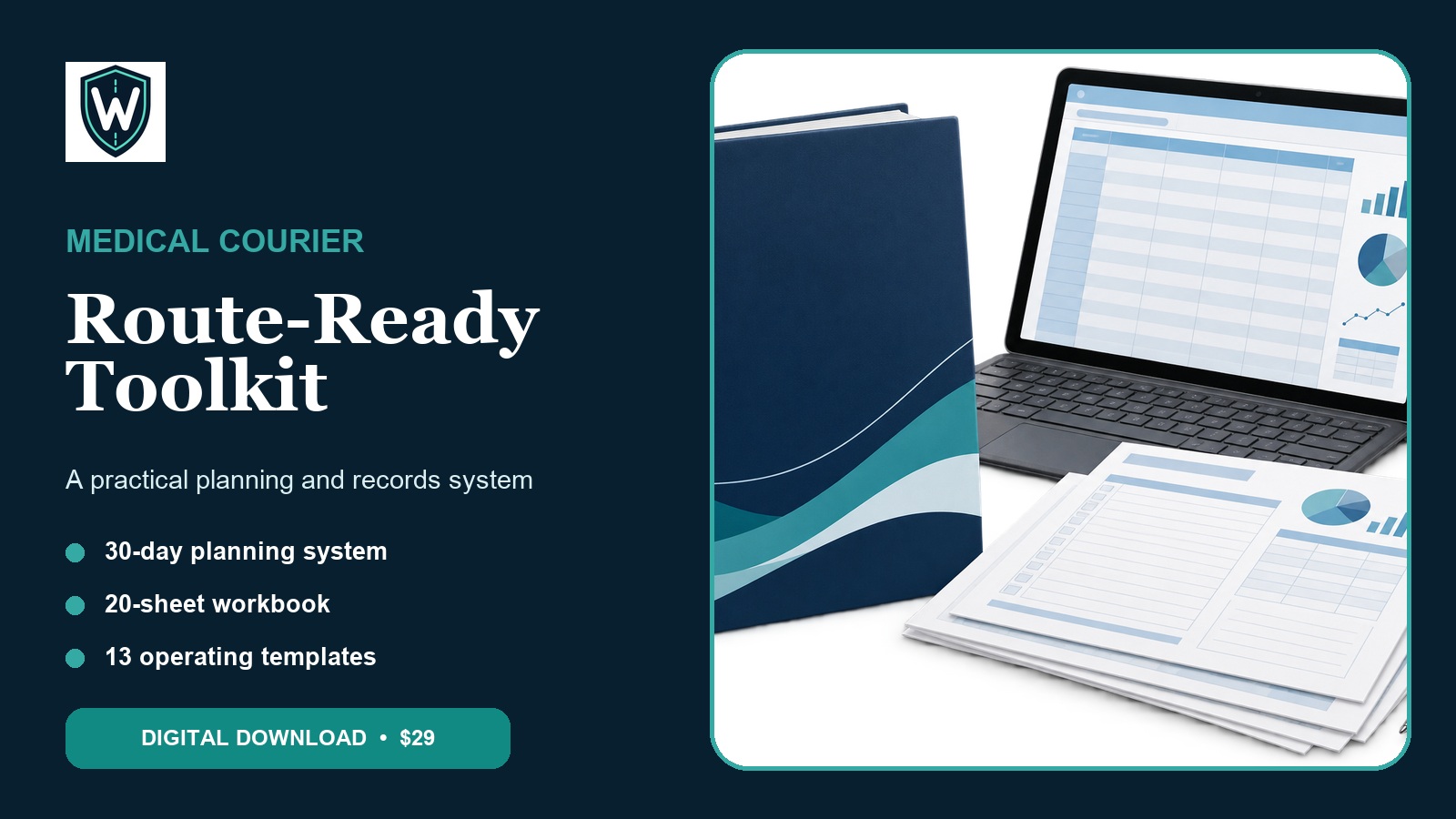
The Medical Courier Route-Ready Toolkit combines a guided planning system, a 20-sheet workbook, 13 editable operating templates, printable forms, official sources, and a single-business-use license.
- Instant digital download
- 20-sheet planning workbook
- 13 editable templates
- Printable operating forms
Get the toolkit for $29
One-time purchase · No physical shipment
Educational and planning materials only. No route, contract, income, compliance, or employment outcome is guaranteed. Review the Terms, Privacy Policy, and Refund Policy.
Step 01 · Understand the work
Know what may be in your custody
Medical couriers can transport many different items. Responsibilities and regulations depend on the actual material—not just the words “medical delivery.”
Laboratory specimens
Blood products
Pharmaceuticals
Prescriptions
Medical supplies
Medical devices
Documents and records
Diagnostic materials
Time-sensitive healthcare items
Do not assume every package follows the same rules. A sealed box of ordinary supplies is not the same as an infectious substance, controlled medication, dry ice shipment, or radioactive medical material.
Step 02 · Choose an operating model
Employee, contractor, route owner, or business?
Each model changes who controls the work, who pays expenses, and which records, protections, insurance, and tax issues deserve review.
Independent-contractor courier
On-demand courier
Dedicated-route contractor
Pharmacy-delivery contractor
Laboratory or specimen courier
Courier-business owner
Contractor with multiple drivers or vehicles
A signed “independent contractor” agreement does not automatically settle worker classification. Review the actual relationship using current IRS, Department of Labor, state-agency, and professional guidance.
Step 03 · Establish the business
Build the operating foundation
Organize the entity, money, records, insurance, procedures, and expiration dates before chasing routes.
Device-local progress
Guided startup checklist
Your checkmarks stay in this browser. They are not a compliance determination and do not require an account.
0 of 16 complete
0%
Step 04 · Vehicle and driver
The details decide the license and registration questions
- Vehicle GVWR
- Trailer and combination weight
- Passenger capacity
- Hazardous-material transportation
- Interstate or intrastate operation
- State law
- Customer requirements
- Own authority or lease-on operation
Avoid universal claims
Not every medical courier needs a CDL, USDOT number, MC number, or special federal license. Research the facts of the operation and verify the answer with the responsible agency.
Use the requirement checkerStep 05 · Medical privacy
Protect information at every handoff
Use official HHS information. A private course is not “government HIPAA certification,” and the federal government does not certify a courier as universally HIPAA compliant.
HHS business associate guidanceHIPAA awareness
Protected health information
Secure handling of manifests and labels
No unauthorized photographs
Mobile-device protection
Lost-item procedures
Privacy-incident reporting
Customer-specific training
Business Associate Agreements when applicable
The limited HIPAA conduit concept
Step 06 · Specimen and package safety
Different contents can mean different rules
Do not package regulated material unless you have the required training, authorization, packaging system, and customer instructions for that function.
Cargo categories to identify
General medical supplies
Diagnostic specimens
Category A infectious substances
Category B biological substances / UN3373
Blood and potentially infectious material
Temperature-controlled products
Pharmaceuticals
Controlled substances
Dry ice where applicable
Radioactive medical material where applicable
Handling and procedure topics
Primary and secondary containment
Absorbent material
Outer packaging
Package markings
Package integrity
Spill and exposure response
Chain of custody
Temperature logs
Incident reporting
Customer instructions
Package acceptance does not authorize a courier to reclassify, repackage, mark, or prepare regulated material. Stop and contact the trained shipper or contracting company when package integrity, labels, temperature, custody, or instructions are unclear.
Step 07 · Training categories
Separate legal duties from customer preferences
May be required by law
Function-specific hazmat, employer-provided bloodborne-pathogen training, or other duties when the rule’s conditions apply.
Required by contracting company
Platform, safety, route, device, custody, delivery, and incident onboarding.
Required by customer
Site access, privacy, pharmacy, laboratory, temperature, identity, or chain-of-custody procedures.
Required because of cargo
Infectious substance, dry ice, hazardous material, controlled item, or specialized package duties.
Recommended industry training
Defensive driving, customer service, spill awareness, cybersecurity, and mobile-device protection.
Step 08 · Equipment
Build a contract-specific equipment list
Confirm every item with the actual cargo and customer. Labels below distinguish common reasons an item appears.
Reliable registered vehicle
Customer or contract requirement
Appropriate insurance
May be legally required
Smartphone and charging backup
Customer or contract requirement
Navigation application
Recommended operating practice
Insulated transport container
Customer or contract requirement
Temperature monitor or data logger
Customer or contract requirement
Secondary containment
Cargo-specific requirement
Tamper-evident seals
Customer or contract requirement
Spill kit
Cargo-specific requirement
Disposable gloves and required PPE
Cargo-specific requirement
Cleaning and disinfecting supplies
Recommended operating practice
Identification badge
Customer or contract requirement
Clipboard or document case
Recommended operating practice
Barcode scanner or proof-of-delivery capability
Customer or contract requirement
Vehicle cleaning log
Recommended operating practice
Maintenance records
Recommended operating practice
Step 09 · Procedures
Document what happens before, during, and after the route
Use these editable placeholders as conversation starters. Customer and qualified professional review may be needed.
Pickup Verification Checklist
Chain-of-Custody Form
Temperature Log
Failed Delivery Procedure
Specimen Spill Procedure
Vehicle Breakdown Procedure
Accident and Incident Report
Privacy Incident Report
Package Discrepancy Form
Proof-of-Delivery Form
Daily Vehicle Inspection
Vehicle Cleaning Log
Training Record
Document Expiration Tracker
Step 10 · Find companies
Ready to research medical courier opportunities?
The directory opens with a medical filter and clearly separates sample layouts from verified live listings.
Last reviewed: September 3, 2026
State-specific research is required.
Wiggins Logistics provides general educational information and transportation-opportunity listings. Information on this website is not legal, tax, insurance, medical, employment, or regulatory advice. Requirements vary by state, jurisdiction, vehicle, cargo, customer, contract, and operating model. Verify requirements with the appropriate agency, company, insurer, attorney, tax professional, or other qualified adviser.